Dr. Mackey Searches the Wreck
Young Captain Jack · The Son of a SoldierDr. Mackey Searches the Wreck is a clandestine expedition in which Dr. Mackey searches the charred Nautilus for proof of a family history and property claim, then steals the documents he discovers in a concealed black tin box. The action is decisive because the wreck is not merely a relic of the disaster that brought Jack Ruthven ashore: it is an archive. By removing its papers, Dr. Mackey attempts to turn uncertainty about Jack's parentage into an advantage for himself, while the later recovery of the box restores the material evidence on which the story's final recognition depends.
Causes and Background
The search is driven by a disputed past that has been obscured by the shipwreck. Marion Ruthven explains that Jack Ruthven was one of the passengers when the wreck came ashore on Hemlock Bluff rocks between ten and eleven years earlier. Old Ben found Jack on the beach in his injured mother's arms, and Jack was brought with her to the Ruthven home. His mother died soon afterward, leaving no marked clothing or identifying papers. The only surviving personal effects were an unmarked lace handkerchief and a ring whose worn inscription could not be read, even after two jewelers examined it.
The wreck therefore holds the possibility of an answer that family memory alone cannot provide. Jack's fragmentary recollection of a storm and enormous waves is uncertain, while the physical objects preserved by the Ruthvens offer only partial clues. The ring appears to be a wedding ring, but its marking has become illegible. This combination of remembered trauma, missing names, and damaged objects creates the evidentiary gap that Dr. Mackey seeks to exploit. His later claim that Jack is his son gives the search an openly personal and financial stake, but the expedition itself shows that he is looking for documentary proof rather than relying only on his spoken assertion.
The Search Inside the Nautilus
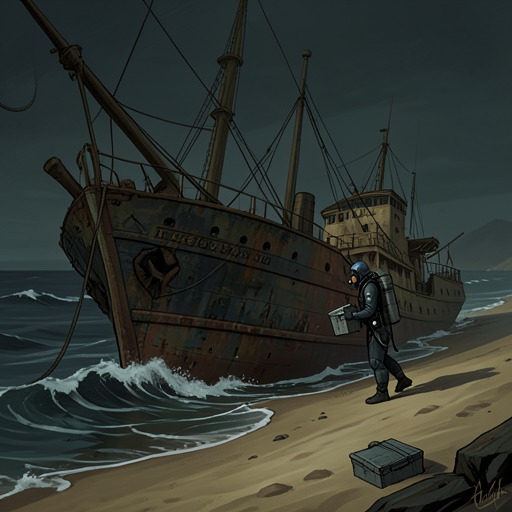
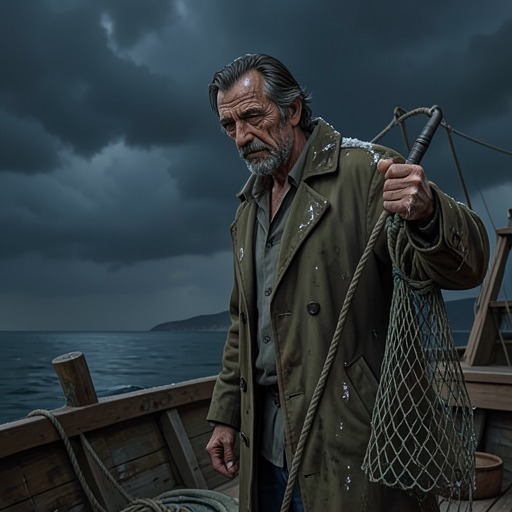
Dr. Mackey arranges for Old Ben to take him to the wreck and promises the boatman a dollar for the return journey. He walks toward the stranded vessel while repeatedly looking back to see whether Old Ben is following, a gesture that makes the expedition's secrecy plain. Old Ben senses that something is occupying the doctor's mind and suspects that he intends to do something improper, though he rows away before the search is completed.
Climbing onto the deck is difficult, and the interior presents a desolate spectacle: everything has been charred by fire. Dr. Mackey nevertheless proceeds into the main cabin, carrying and lighting a candle. He first finds a stateroom marked number 7, then reconstructs the numbering system, reasoning that the rooms on that side are odd-numbered and identifying the next likely room as number 15. The number plate is gone, but the partly open door allows him to enter a room stripped of movable objects and coated with dust and cobwebs.
His search becomes methodical rather than random. Remembering that a small closet had been set into the wall at the foot of the bed, he tests both ends of the room by tapping the woodwork with his knuckles. He finds a hole where a knob had once been, uses a bent nail in place of the missing handle, and pulls until the concealed door opens. The closet is about a foot square and is filled with dirt and water that entered through a crack at the top. Digging through the compacted dirt, he uncovers a heavy tin box painted black.
The Theft of the Evidence
The box is secured by a small padlock. Dr. Mackey tries a bunch of keys from his pocket until he finds one that fits and opens it. Inside are the papers he wanted: a marriage certificate, letters from the man's father concerning property, and letters from the woman's family. The documents connect marriage, parentage, and inheritance in a single packet, making them far more powerful than the damaged ring or the unmarked clothing retained by the Ruthvens.
Dr. Mackey's response reveals the purpose of the expedition. After examining the documents, he puts them back into the box and declares that the fortune is his. He then returns to the closet and cleans it out thoroughly, checking for anything else of value. Finding nothing more, he blows out the candle, hides the locked tin box beneath his coat, and returns to the deck. The care taken to search the closet again and the decision to conceal the box under his coat show that the act is deliberate theft, not an accidental discovery or an attempt to preserve the wreck's contents for lawful authorities.
Consequences and Recovery
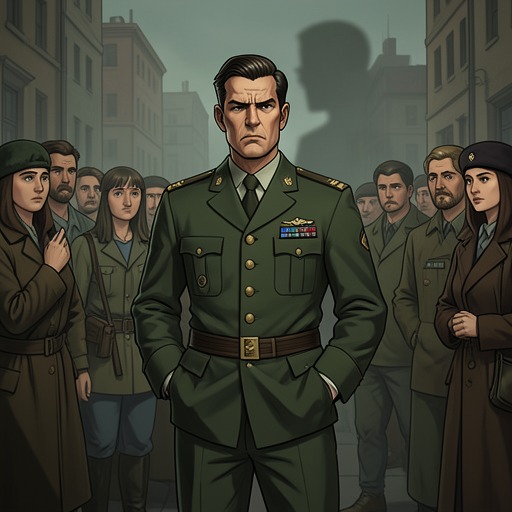
The stolen papers later become the material foundation of Colonel Stanton's recognition of Jack Ruthven. While Colonel Stanton lies feverish, he cries out about a shipwreck and asks that his wife Laura and his son Jack be saved. His resemblance to Jack, his reference to Laura, and his recollections of the disaster revive the possibility that Jack is not Dr. Mackey's son but Colonel Stanton's child. Colonel Stanton understands that the question can be settled only by proof and asks whether anything belonging to the woman has survived.
The search is also linked to Dr. Mackey's broader scheme. Colonel Stanton explains that Dr. Mackey had learned his family history while he was confined in an asylum, where the doctor drugged him after extracting details about property in England and an estate in Virginia belonging to his wife. This account clarifies why the documents on the wreck matter: they can substantiate the marriage and the inheritance that Dr. Mackey has tried to appropriate while claiming Jack.
The box does not remain in Dr. Mackey's possession. After Jack returns home, a battle in the mountains kills several of the guerrillas who had held him prisoner, including Pete Gendron, and Gendron dies without revealing what he knows of Dr. Mackey's past. A thorough search of the outlaws' camp uncovers stolen goods and other valuables, including the black tin box taken from the Nautilus. The box and its contents are then handed to Colonel Stanton. When he examines the papers, he tells Jack that nothing now stands between them and their fortune. The earlier theft consequently produces the opposite of its intended result: the evidence is recovered, Mackey's temporary control over the inheritance collapses, and the father-son recognition receives documentary confirmation.
Narrative Significance
The episode gives the identity plot a chain of physical clues rather than leaving its resolution to resemblance or emotional conviction. The wreck first appears as the place where Jack's unknown past ended in catastrophe; the ring and handkerchief preserve traces of that past; the feverish recollection of Laura and Jack reactivates it; and the tin box finally supplies the written record. Each object moves from obscurity toward explanation, while Dr. Mackey's attempt to remove the evidence temporarily reverses that movement.
The scene also exposes the contrast between possession and rightful claim. Dr. Mackey finds the documents, but finding them does not make the fortune his. His triumphant conclusion depends on concealment and coercion, whereas the later transfer of the box to Colonel Stanton places the papers within a public chain of recognition involving Jack, his adoptive family, and the recovered family history. The burned ship, the hidden closet, and the black box thus form a compact image of the novel's central conflict: truth survives disaster, but greed tries to bury it again before it can be read.